Monday, May 9, 2011

Livin´ Large in the Big Easy


New Orleans gets a lot of hype. It´s deemed one of the best places to party in the US, the best place to get some jazz, the best place to clog your arteries with delicious and distinctive food; it also caught the attention of the world in 2007 with the devastation it suffered because of Hurricane Katrina and the country´s ineptitude in handling the aftermath.  New Orleans does encapsulate all of these things, yes; but during my week there I got the feeling, more than with other cities, that New Orleans is all about perspectives.  Every perspective is valid in its own way, but no one perspective encompasses what the city really is, not in its entirety.  Each is a narrative of experience, of what we as individuals saw or chose to see.  There was the Dutch guy in the hostel with a suspiciously Russian accent who spent every night on Bourbon Street and every day recovering under a tree in the courtyard, and my couchsurfing host who didn´t believe in bad neighbourhoods, only overly paranoid people who attracted negative attention.  Then there was Chad, who had spent all his life in New Orleans and recently moved to Atlanta.  He was back to work at Jazz Fest, but he couldn´t wait to leave New Orleans; he hates the place.  He told me about the deep-seated racism that´s getting worse rather than better.  The corruption of the police force, the degradation of the schools (New Orleans had only a 40% literacy rate before Katrina), the fearless gangs of young people who have no qualms about killling someone who walks onto the wrong street.  "You see all these people here enjoying themselves? Black people, white people...at the end of the festival it´ll all just go back to how it was, they´ll go back to hating each other."  It´s a damning view, but it´s his perspective and it´s not wrong.

My perspective was a bit different, though.  I´m a bit in love with New Orleans, with the booming personalities and the po´boys and the music.  Music has a different status there: it´s as ubiquitous and essential as the food.  The people there have suffered, and it dates to well before Katrina, though her name still hangs over the city and frequently slides into conversations.  I was sharing lunch with a lady from Baton Rouge who was also volunteering at Jazz Fest my first day in New Orleans, listening to her stories of 20 people staying in her house for months after the storm because they had nowhere to go, and the tales of water rising faster than the people scrambling up the stairs to their attics, when the waitress caught a snatch of it.  "Are you talking about Katrina?"  "Yeah."  "Yeah..."  And that mutual, slightly pained, almost reverent pause before the stories continued.  But life goes on, because it must, and to me, it seemed the music is a catharsis for all that hardship.  On street corners, at the Jazz Fest, in dive bars, in front of coffee shops, people poured out music, damn good music.


 But on to less serious things.  My first few days in Nawlins was spent toing and froing to the Jazz Fest, where I jammily managed to get a volunteer position.  My expertise now extend to children´s canvas painting assistant, Assess Tent sitting, and Recycling Centre standing.  But even better than gaining this CV-worthy skillset, I got to see Mumford and Sons, Tom Jones, The Decemberists, Low Anthem, bits of jazz and bluegrass, and on and on.  So not a bad endeavour at all in the end. 

The hostel I stayed in for the first four nights was delapidated but clean, and more importantly full of interesting folk happy to swap tales over a beer or five.  One man, who´s currently moonlighting as the maintenance guy, used to work on a pleasure boat that was right next to Deepwater Horizon when it exploded last year.  He´s currently waiting for his $450k cheque from BP to come in and quite looking forward to it.  Among others, there was also an 85 year old Swiss man who´d lived most of his life on the Amazon carrying tourists to and fro, and a doctor from Brazil who played violin, but only with a backup track and speakers - he held regular nightly concerts by the barbecue.


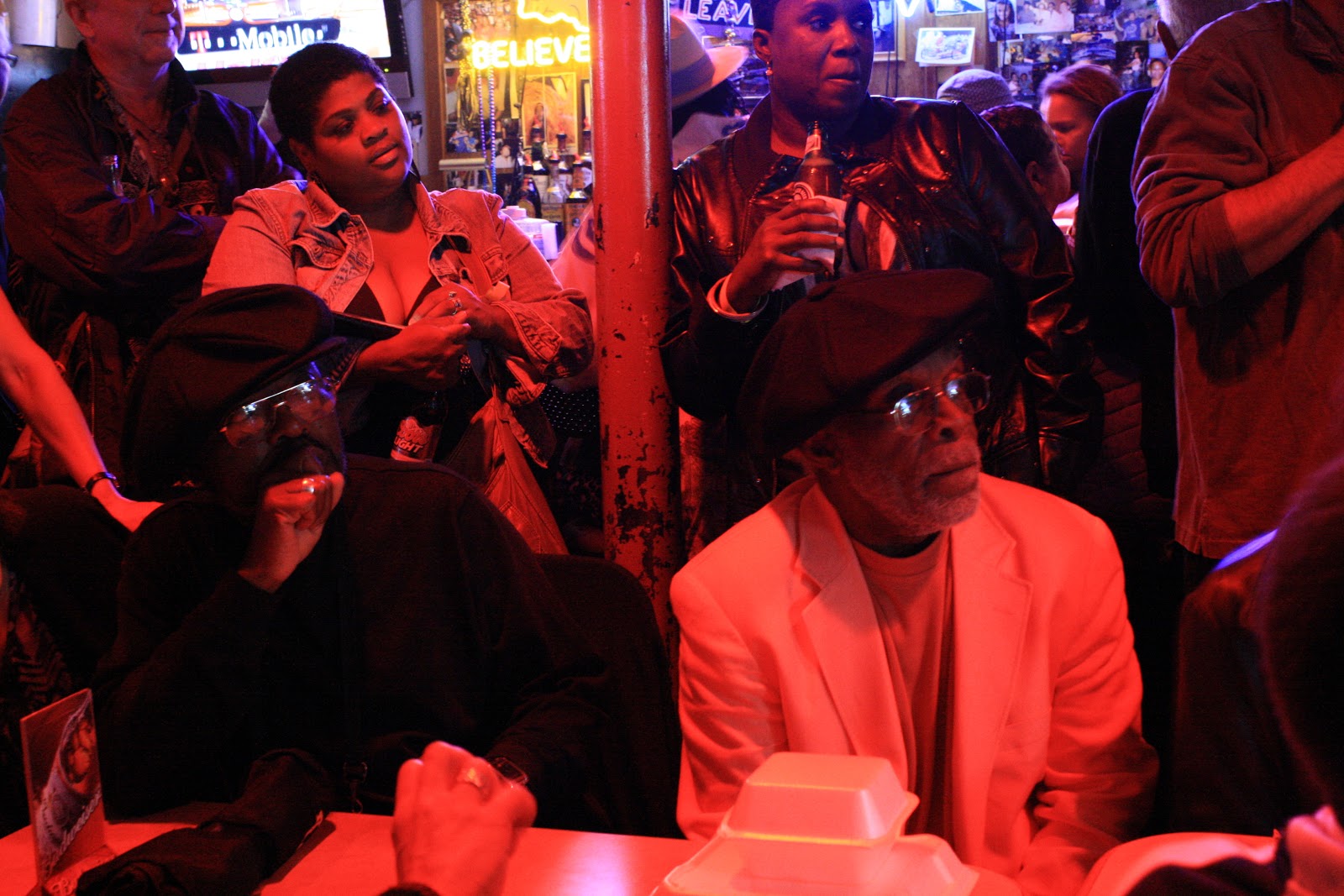
The final three days I stayed with a Couchsurfing host and became travel buddies with another Couchsurfer who was staying there.  Together we were able to tick crossing the Mississippi, seeing City Park and its associated bayou, and getting in some proper dive bar jazz off our lists.  The dive bar in question was called Bullet´s Sports Bar, and for all you Treme fans out there, yes it was the Bullet´s featured in the first season with Kermit Ruffins.  


I finished out my last night in New Orleans with a good old cheesy ghost history tour.  Not one to shirk cultural responsibility completely, I picked a tour that leaned heavily on the history side, and it provided a (mostly) factual look of the weird, twisted past of the French Quarter, with a bit of flair thrown in ford good measure.  Our tour guide had a colonial Indian accent that suited his flowing garb and feathered trilby, and his penchant for cackling at the end of each harrowing vignette served its unnerving purpose.  Among the bits of insight gleaned from the tour (which, by the way, I would recommend to anyone visiting: Haunted History Tours) were that all the buildings in the French Quarter bar three are actually in Spanish colonial style due to the entire area and all its wooden buildings burning down twice in the space of six years, the inhabitants are descended pretty much exclusively from convicts and prostitutes shipped over from France (the first time the convicts asked the king for women he sent them over nuns), and Johnny Depp has recently bought a very haunted house from Nicholas Cage which seems to bring a curse on all its owners which he intends to turn into a museum in the next year.

I definitely left New Orleans with a taste of more in my mouth (and not just for the bienets from Cafe du Monde); hopefully I´ll have a chance to dine once more on the Big Easy.

Nom nom nom...Later ´gators.


 Next stop, Quito. Photo albums are temproarily suspended until I figure out a place in South America that doesn´t take 5 hours to upload a single picture.

Update: More photos of New Orleans can be viewed here.


Sunday, April 3, 2011

Departure from the House of the Sun

Somewhere between the snow drifts and the extended sunsets, three months managed to slip by unnoticed, and so my Icelandic adventures have come to an end.  I'm once again packing up my possessions and willing, cajoling, and threatening my bulging bag into closing. My time at Sólheimar is finished, and as I glare at my unpacked bag, my thoughts are on the past three months.  It is said that REM cycles go in 3-hour segments, a theory which, whether it be true or not, I can oddly attest to: 3 hours of sleep is better than 4, 6 hours of sleep is better than 7, and 9 is simply dreamy.  For the same people who buy into this questionable hypothesis (semi-guilty as charged), I propose a similar theory for time cycles: the seasons come in 3-month segments, the financial quarters come in 3-month segments, and 3 months seems to be the time when you finally begin to settle into a new place.  So of course, in true vagabond style, I'm ripping up my roots before they grow too deep, gathering them about me like a pile of cumbersome petticoats, and waddling on down the road. 

So what has been my experience working in an eco-village in Iceland?  Sólheimar isn’t really an eco-village, and so it shouldn’t be advertised as one.  The way of life isn’t particularly focused on living in an ecologically friendly way, and in this respect it doesn’t add up to other well-known eco-villages in the world; some of the more extreme like Findhorn in Scotland and Lammas in Wales come to mind.  But whether or not Sólheimar is a sustainable community isn’t as black and white.  Obviously the issue of eco-mindedness will come up here as well, but there is more to sustainability than this.  A truly sustainable community is able to continue itself in all aspects: population, culture, life-satisfaction.  Sólheimar is a vibrant, thriving community, and that itself is an aspect of sustainability that is difficult to find.  It's a place where after a few days people will recognise your face, and if you're not at the morning meeting or at work, someone will come by your house to make sure you're alright.  Its inhabitants look after each other, but they're also very willing to accept new people, whether they're just visiting or here to stay.  Sólheimar has people with intellectual disabilities, physical disabilities, terminal cancer, people who are completing their prison sentence, artists, and students.  It has an organic tree nursery, greenhouse, and bakery; creates ceramic, wax, carved, and textile art; it has a choir, theatre group, and chicken coop.  I was surprised that when it came time to say goodbye, it was quite tough.  I’ve done a lot of moving around, and three months isn’t much time, all things considered, to feel like you can know a place well enough to really miss it.  But Sólheimar is a special place.  The people don’t put up walls like they do in other places, and because it’s all about the community, you become a part of it almost immediately.  And leaving that, knowing you’ve had your own little part to play in it, is difficult. 

While it hasn't taught me about life in an eco-village like I had hoped, it has taught me things I hadn't expected.  And so for all of that, I say takk fyrir, Sólheimar.  This place is doing some wonderful things, and has the potential to do everything it sometimes implies it does.  I wish it and all the people in it health, happiness, and above all else, a sustainably run pub.


Café-Hopping in Reykjavik, or, Why I Couldn't Sleep on Wednesday Night

My battery was dying and there was a plug in the corner, but to get to it I’d have to confront the table full of English gap year students behind me who had been discussing the healing properties of the ocean and the epic night of drinking followed by vomiting they had the night before at length for the past hour, and the comfort of staying where I am was just not worth dealing with such an interaction.  I packed up and shipped off into the lashing Icelandic spring day.  I was caught at that awkward time when some cafés close and others with alcohol licenses remain open and slowly transform into a pub with the gradual descent into evening and inebriation.  I scuttled from café to café looking for one that would stay open long enough for me to finish my work, but as I’d forgotten the word for “closed”, I was left mumbling the awkward phrase, “At what time are you not open?” wherever I went.  


Generally my Icelandic is atrocious and I can only manage a few mangled words.  But in Reykjavik, where most of the foreigners congregate and everyone speaks English, I try stumble through basic conversation and am mighty pleased with myself when I succeed.  Although the polite smiles the waitresses give me are probably fuelled by pity at my lack of vocabulary or grammar of any sort, I like to delude myself by hoping that I may have them fooled into thinking I’m just a very reticent local.  In the café, I was able to order “Kaffi og kleina, takk” while the girl behind me conducted her order in English.  After I finished my coffee and a suitable amount of time passed, the waitress came up and asked something.  A master of context clues, I knew she was wondering if I wanted anything else.  “Nei, takk.”  Nice one, I totally had this.


When it came time to pay the bill, I passed the test by mumbling incoherently and making the international, “I’d like to sign the bill now” motion.  In the home stretch now, I was going to make it!  But then she asked me a direct question.  I smiled.  She waited.  I smiled again…she waited.  “Ha?” - “What?” in Icelandic; I could have just been hard of hearing.  Not that repeating it would help me any.  She asked in English, “Do you want the receipt?”  I looked bashfully at the floor.  “No, thanks.”  Defeated by a technicality.  Better luck next time.   

Hoi, Who Drank MyVatn? And Other Second-Rate Puns

Last week found us a mere 90 km from the Arctic Circle and loving it. Claire and I, sharing a common love of good beer and random sounds, decided we'd make a good team on an expedition up to the the snowy north, and so on Thursday evening we began the six hour journey with nothing but the steady row of power lines and the ubiquitous whiteness as company.  We stopped first in Akureyri, the self-proclaimed capital of the north.  Since the real capital has only 200,000 people and two or three main roads, we thought it best to set our expectations beforehand.  What we didn't expect was a 15-foot snowman in the centre of it all...

Snowman done gone and got himself super-sized...
After our initial frosty reception, we strolled about the town taking in the sights.  In fairness, there aren't many of them; but Akureyri does have quaint picturesque buildings and boasts ice cream good enough for Reykavites (self-coined term, I think it'll catch on) to travel up for.  Yes, I did sit outside in sub-zero temperatures eating ice cream.  Whatever; when in Rome, get hypothermia. 


The next day we rented a car and made our way to Myvatn, a lake about an hour's drive to the east.  Named for the massive black columns of midges that swarm the place during the summer months, Myvatn is like a geologist's Valhalla, except without the dying part.  It has volcano craters, it has steam plumes, it has oodles of waterbirds, lava pillars, hot springs, caves, squidgey algae balls, nature parks...In short, it's a pretty damn cool place.  The only thing better than touring all these sites is touring all these sites while being hosted by a local.  We stayed with probably one of the most hospitable Couchsurfers in the world, who welcomed us into his home and showed us all around the area for two days.  He comes from a family of sheep farmers, and during our time there he showed us some of the work they do.  In recent years they've stopped selling the sheep to meat producers and have started handling all of the preparations themselves.  He said this way they can get a much fairer return for each sheep, and they can also ensure that there's as little waste as possible.  I could tell that for him using everything that could be used from the animal went well beyond costs; it was about respecting the sheep and not being cavalier about the process.  His family produces artisan sausages and meats at the moment, and are even experimenting with a smoked sheep meat similar to the jamón you find hanging in shops in Spain.  I still had fresh in my mind an article I'd read a week previous about the horrible conditions for both chickens and chicken farmers in the US because of the meat monopoly large companies have created, and it was great to see farmers taking matters into their own hands to demand fairer livelihoods for themselves and maintain better lives for their stock.

On Saturday we started at Hverir, the sulfur fields full of grey bubbling mud pots.  Now, mud pots stink a lot, but we thought we were old hat at eau d'sulfur, since every time you turn on the hot tap you get a whiff; however, nothing could have prepared us for this.  To pin it down, I'd say the smell was the usual rotten eggs, mixed with a tin of rancid tuna, wet dog, and the severe body odour of a champion sumo wrestler after a particularly arduous match.  Gag reflexes were well-exercised after a stroll around here.  But still, it looked pretty cool.  NASA has been known to bring astronauts up to train in its lunar landscape.

Just be thankful it isn't scratch 'n' sniff...
Next stop was Dimmuborgir, the site of lava pillars and rumoured home of the Yule lads (see episode 2 for more on them).  


Shortly after, our host took us to the locals' favourite hot pot cave to unwind after a long day of sheep shearing (his) and having a laugh (ours).  The water was a steamy 45 degrees, and this particular hot pot sits in the rift between the continental plates.  Because of its location, it also means that I swam from America to Europe. That's one more thing to tick off the list so, pat on the back.

The next day brought a lot of "My God, but we are jammy dodgers..." moments, as our host took us snowmobiling and ice fishing.  The snowmobiles themselves were aging, albeit loyal, beasts of burden: one didn't start unless it was on a hill, the other didn't steer, and neither had brakes any more.  Claire and I clamboured onto the one without steering, and dutifully threw ourselves to one side or the other based on where we wanted to go, hoping the thing would go more or less in the direction we needed.  It generally worked out fine, until Claire got a bit over-zealous and started doing spins on the ice.  Spectacular wipe-out; chuckles had by all; no reported deaths.

Photo by Claire Cornet
Ice fishing was done the traditional Icelandic way: bore a hole the size of a decent pancake into the ice, bait your dorga (fishing rod made from a bent sheep's horn) with some shrimp slightly cooked by the heat of the snowmobile engine, and then wait.  We had forgotten to bring some beer or hot chocolate, which was a grave oversight, but other than that I think we did a pretty good job.  Except for the catching fish part.  Out of the four of us, the only one who caught a fish was Claire, the vegetarian.  She had firmly stated that she was only there to feed the fish, and when she felt something tugging at the line she screamed, "Noooo, let go, be free, don't bite it!"  But the deed was already done, and so there was nothing left to do but smoke a cigarette.

Photo by Claire Cornet
The rest of the day was filled with a visit to the bird museum and a few more sites around the lake.  By the time we left on Sunday night, we were overwhelmed by true Icelandic hospitality and the natural beauty of the Myvatn region.


Monday was hitchhiking day, and we traipsed some 20 minutes outside the town to strategically position ourselves on the only road to Reykjavik, hopeful that no one would be able to resist our smiling faces and Claire's strawberry hat.  Over an hour later, it had begun to snow, what looked to be the same woman had passed us for the fourth time, and I was in desperate need of something to look at besides the changing lights and the construction company sign across the road.  After a short lift that carried us 8 km down the road and another half hour, an electric blue Ford Focus pulled over and we jumped in.  And so we came to meet Magnus, the old fisherman from the East.  He spoke very little English, but had a kind, slightly awkward nature and was going all the way to Reykjavik.  After a quick exchange of half-Icelandic half-English sentences and a few minutes of weighty silence, he pointed to the CD player and asked, "You music?"  I gave an eager, "Já, já!", and when he pressed the eject button out came Mamma Mia!.  He turned slightly red and mumbled, "This is my wife's car..."  

Two complete runs of Abba covers, two CDs of Icelandic country singers, and a stop at the Viking restaurant later, we were back in Reykjavik.  We said a warm goodbye to Magnus and headed down the small crowded shopping street into the city twilight.

More pictures when I figure out how to fix my computer.


Saturday, March 5, 2011

Snæfellsnes and Friends

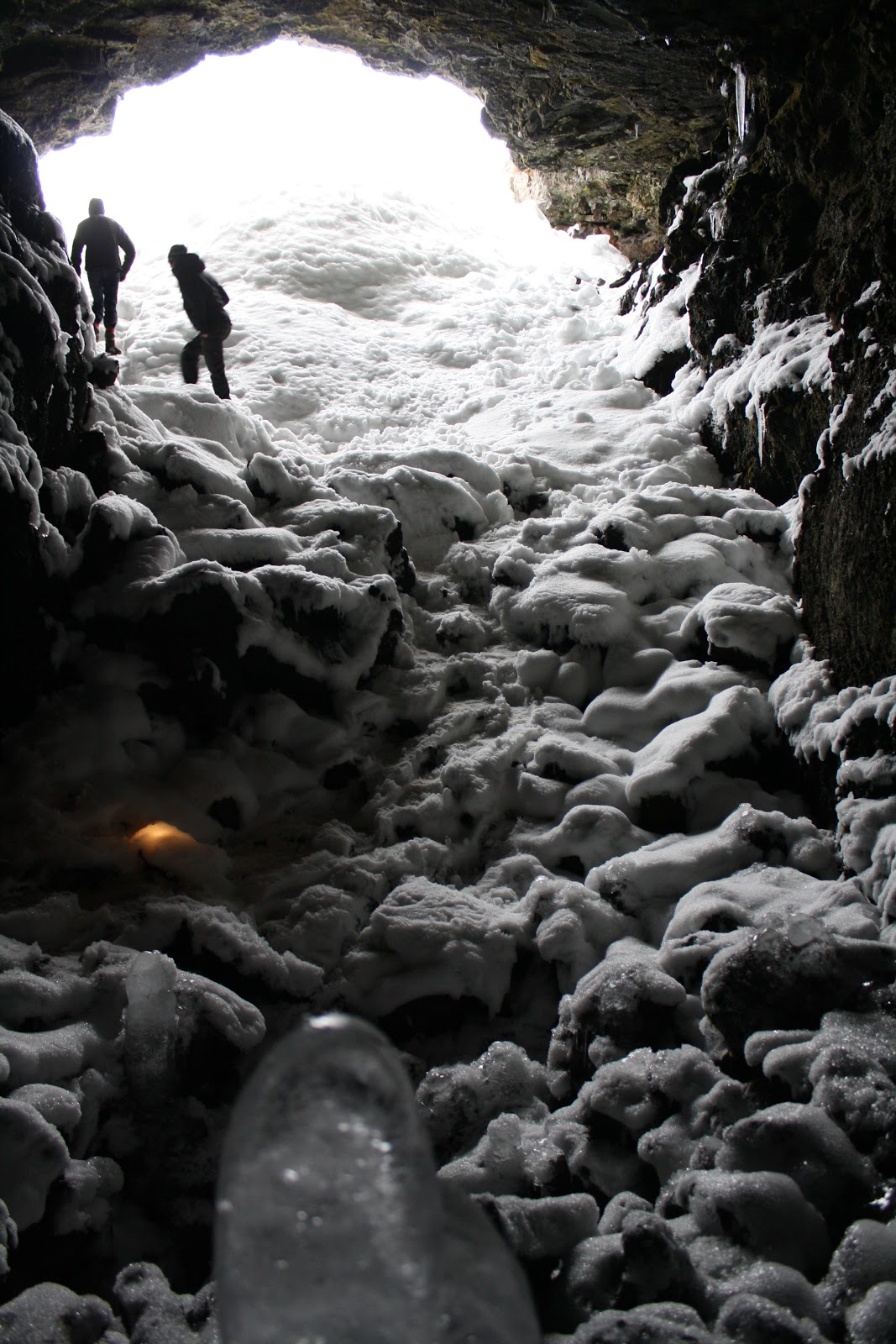
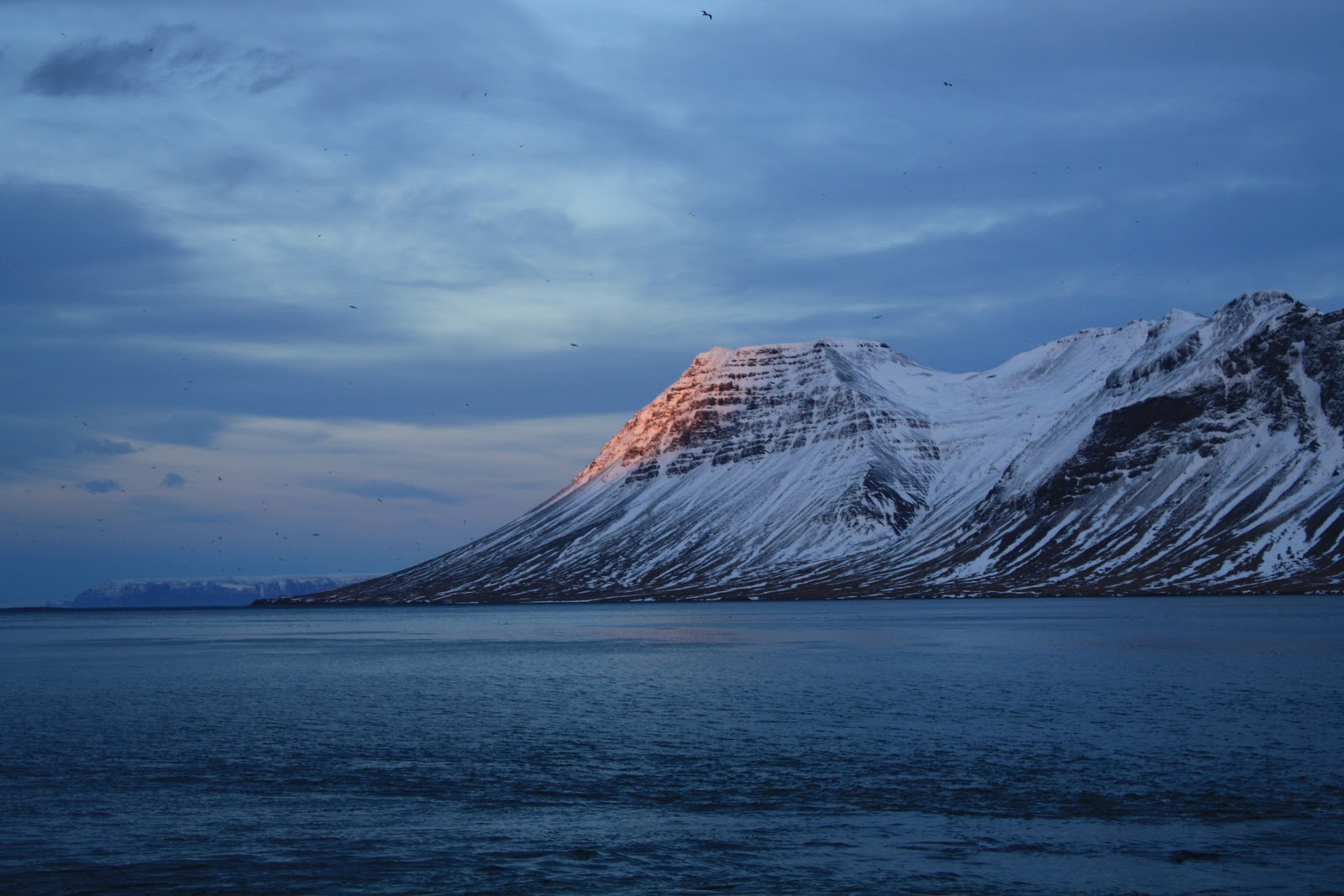
So it turns out Iceland can get even more beautiful than the thermal springs, volcanoes, and geysers of the south.  Enter Snæfellsnes, the finger-like peninsula on the west coast above Reykjavik.  It may sound like a children's show character, but this place is shockingly beautiful.  It has its own volcanoes and glaciers to brag about, and it was the setting of Jules Vernes' Journey to the Center of the Earth.  It is also believed to be a place of great spiritual energy and supernatural activity, if that floats your boat.  Chakras and novels aside, our weekend was spent climbing volcano craters, exploring hidden caves, walking cliffs, and watching Northern Lights in one of the most stunning places I've been.  Two thumbs up to you, finger-like peninsula!


View from Stykkishólmur lighthouse
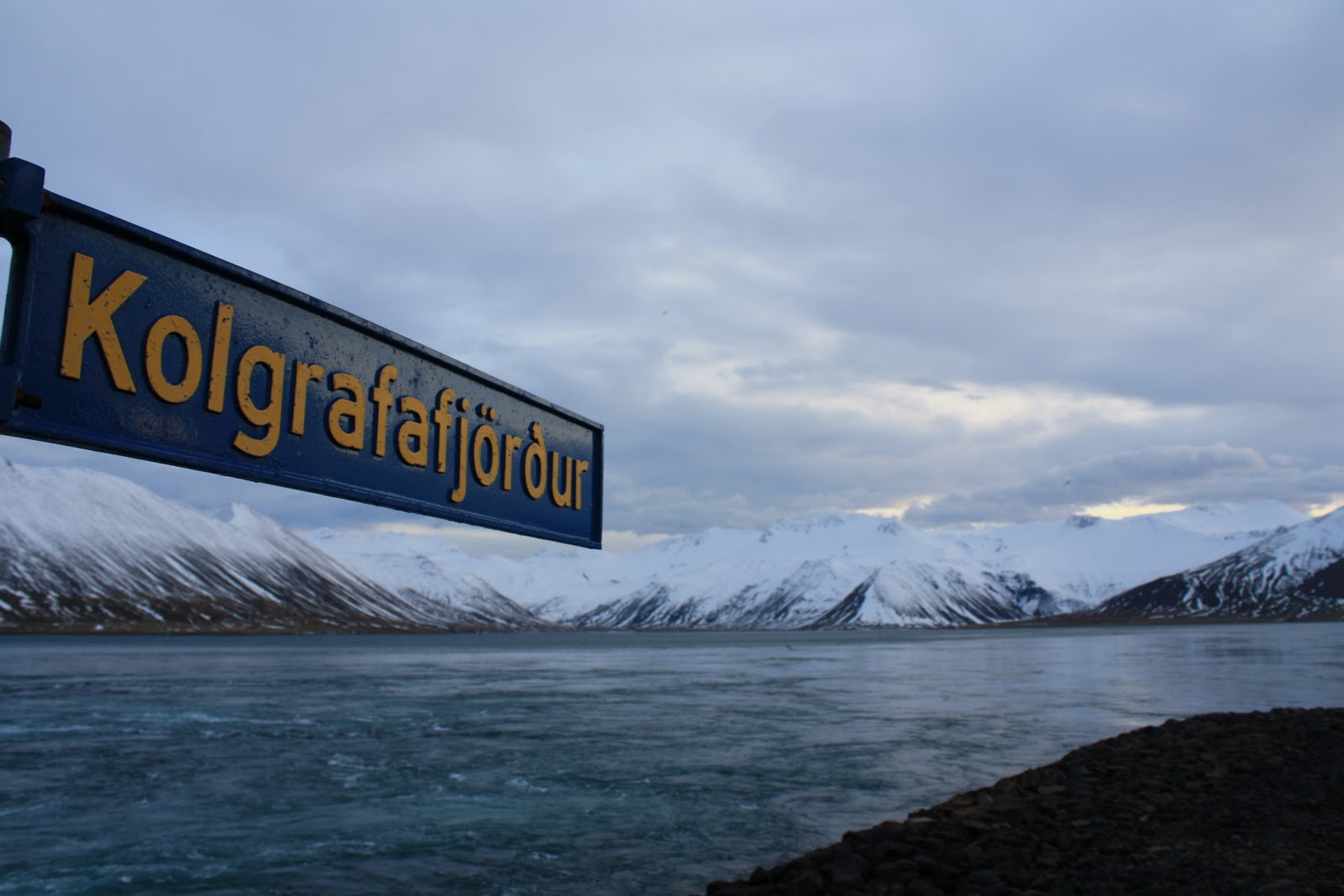
The fjörd of Kolgrafa, of course...


Now before we'd left for our adventure, my supervisor's boyfriend had given us some tips about what to see in Snæfellsnes.  He advised staying in Stykkishólmur overnight.  The smaller towns of Ólasvik and Grundarfjörður were worth having a coffee in, but he told us that they were the kinds of towns that if you went to the pub at night and said you were from the wrong country, you'd get a punch in the face.  Oh, those types of towns... As it turned out, the hostel we stayed in was in Grundarfjörður but we avoided the pubs, and thus returned home with our noses intact.  Our minds may have received a bit of a battering with the ontological conundrum that met us in the hostel, however...

"This is Not Here." It's not? But..I could have sworn...isn't the...it's...never mind.
Mind games and disgruntled locals aside, Grundarfjörður had its own gems to behold.  On the Saturday night we were treated to Northern Lights over the sea.  Add good company and a can of Polar Beer (yes, the mascot is a polar bear), and you have one very fine evening indeed.  It ended as only such a night could, watching Lawrence of Arabia with Icelandic subtitles.


Back in Sólheimar, we've reached that irksome time of year when Spring is trying to begin, but Winter doesn't want to relinquish its hoary grip.  It's as heartening as watching a doberman and a chihuahua fighting when you've put all your money on the under-dog.  The snow is followed by rain, which is followed by hail (wash, rinse, repeat) and the subsequent slush lies in waiting on the dirt roads, ready to ambush oblivious feet everywhere.  Wet socks abound.  This is the springter of our soggy discontent.  

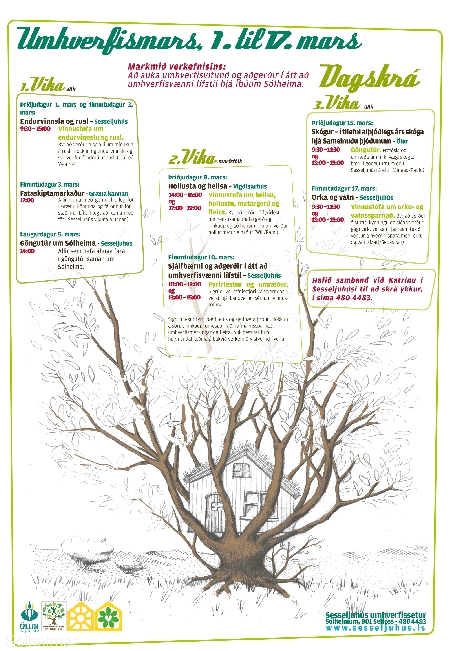
Things soldier on regardless.  This month is "Environmental March" (the pun only works in English, alas), a collection of recycling workshops, sustainable cooking classes, and the like put on by the interns for the home people and helpers in the village.  
Ok, so it's in Icelandic, but you get the gist...
The goal is to raise more awareness about sustainable living and to get the villagers involved in acting in a more eco-friendly manner.  So far Claire and Yvonne have held recycled craft classes and Paulo has put on a "Will my Grandchildren See this Plastic Bag?" quiz game.  Pami and Will are preparing their locally sourced cooking class for next week, and Paulo and I are getting our forest walk and planting workshop organised for the following week.  They're small things, yes, and deal with issues that should have been addressed a long time ago in an eco-village, even one that focuses primarily on reverse integration for people with disabilities, but it's a start. 

Sometimes, you just need to stop stressing about the monumental task ahead, and get on with it.  It's like reading all the news about climate change deniers, the constant slips and setbacks in green policy that governments undergo (most recently Republicans in the US voted to bring back Styrofoam to their canteen, because it's more "fiscally responsible".  First of all, idiots.  Secondly, why is their attention focused on the utensils in their canteen and not something a bit more important like, oh I don't know, pretty much anything else?!), the droughts and natural disasters that are setting us up for a potential global food crisis this summer, the fact that roughly one third of all the food produced in the world is wasted and could potentially feed one billion people (it is speculated that the irrigation water used to grow all the food that is thrown away is enough for the domestic needs of nine billion people - see here for more facts and figures if you're interested)...It all gets pretty grim after a while, and it inspires the two most useless emotions: guilt and helplessness.  Most of what's going on, depending on how it's presented, will cause an "Ah feck, this is all really bad, and I'm a part of it, and sure I can't do anything because it's too big, so what am I meant to do like?!  God, I'd love a pint..." reaction and we'll want to just ignore what's going on because we feel like there's nothing we can do.

But the answer isn't to ignore it (I included the links on purpose); the important thing is to not get overwhelmed by the issue.  Sure, we're all doing things that are adding to the problem.  We all could be doing a bit more of this and a little less of that.  But instead of feeling guilty about it and then clamming up because we don't want to listen to things that make us feel guilty, change something.  Just something small.  Start composting food scraps, or make an effort to buy foods with less packaging, or try to buy fresh fruits and veg at a local farmers' market if possible instead of buying grapes from South Africa and watermelons from Brazil (unless you happen to be from South Africa or Brazil, in which case, congratulations for being the most international reader!).  And then concentrate on that thing you've done, bask in the warm fuzzy feeling of benevolence, and use that warm fuzziness to fuel another change.  Is composting a few old apples or using a canvas bag going to save the world?  No.  But doing those little things to start, and feeling good about them, is so much more productive than becoming stagnant in a flurry of guilt and denial and running to the nearest bar of chocolate to make yourself feel better.  

And on a larger scale, we need to be aware of what's going on, but also make sure we look for the good things as well.  I recently read an article about new technology that uses seawater and solar power to entirely fuel and irrigate greenhouses.  I then came across an article about six "Ethical pioneers" who are fighting the good fight online, through activism, in economics, and more.  I came out on the other side thinking, "Hey, we can actually do this.  We're a bit of sticks in the mud sometimes, we humans, but look at all these great ideas.  We've been in space and built a 27 km tunnel that crashes protons into each other; we can fly, for feck's sake!" We are capable of sorting this out, this and far more besides, if we just get down to it.  Sure, funding is in the wrong place and the system in which the world currently operates holds profit as the bottom line and there are plenty of barriers, but concentrating on why we can't succeed isn't going to do anything.  As a fortune cookie once told me, "The person who says something is impossible should not interrupt the person doing it." We've got a lot of work to do, lads, and we're not going to get it all sorted in one go; but what do you say we start anyway?

~~~~~

Soap box is resolutely put away for the moment.  Since we've given back the cars, we're having our first quiet weekend in a month, unable to galavant around the countryside like the good old days.  We considered renting horses for this month, but alas, we have no hay.  It's just as well we're about the village I suppose.  Apparently last time we were in Reykjavik my wine-induced loquaciousness arranged to play a concert with an Icelandic opera singer in the church this weekend.  So now I find myself practising the guitar solo of "Let it Be", on violin, to be played during mass, with an Icelandic opera singer.  The things I get myself into...

More photos of Snæfellsnes, caves, and the like can be found here.  

Wednesday, February 16, 2011

Green Sky at Night, Quite a Delight...

So Monday night was Valentine's night, and I arranged a light show for my fellow interns to commemorate the day.  Of course, by "I" I mean the magnetic pull of the Earth's poles mixed with solar flares, by "arranged" I mean I was a lucky fool to witness, and by "light show" I mean the most ridiculously amazing natural thing I've probably ever seen in the sky (so I suppose that last description is still fairly valid).  I've seen the Northern Lights already on two or three occasions in the last month and a half, but never anything like this.  Before they were just faint wisps of green in the night sky; last night they were undulating streams of electric rain shooting across our entire field of vision and beyond, curling, waving, and pulsating before fading away again.  Definitely an encounter with the Sublime, one so powerful it would have knocked poor Wordsworth right out of his little paddleboat - the only thing we could do was slump to the ground and lie on our backs, mouths agape and appendages slowly numbing in the snow.  The Lights were so strong, you could actually hear them, a slight swishing now and then.  Much louder, and perhaps more atmospheric, was the fitful sound of the unseen horses left to pasture in the field behind our house.  The horses apparently didn't see the romantic side of this mesmerising display; I suppose if I were a horse, I'd have been a bit freaked out too.

Because the Lights were constantly moving, I wasn't able to get decent photos of them.  However, take two parts the photos below, one part the swirling waves from "The Sorcerer's Apprentice" in Fantasia (if your memory is failing you, see from 3:45 onwards here) and you should have the right idea.  If you really want to get authentic, mix in some uneasy horse whinnies and lie down in a pile of snow/ice for half an hour.


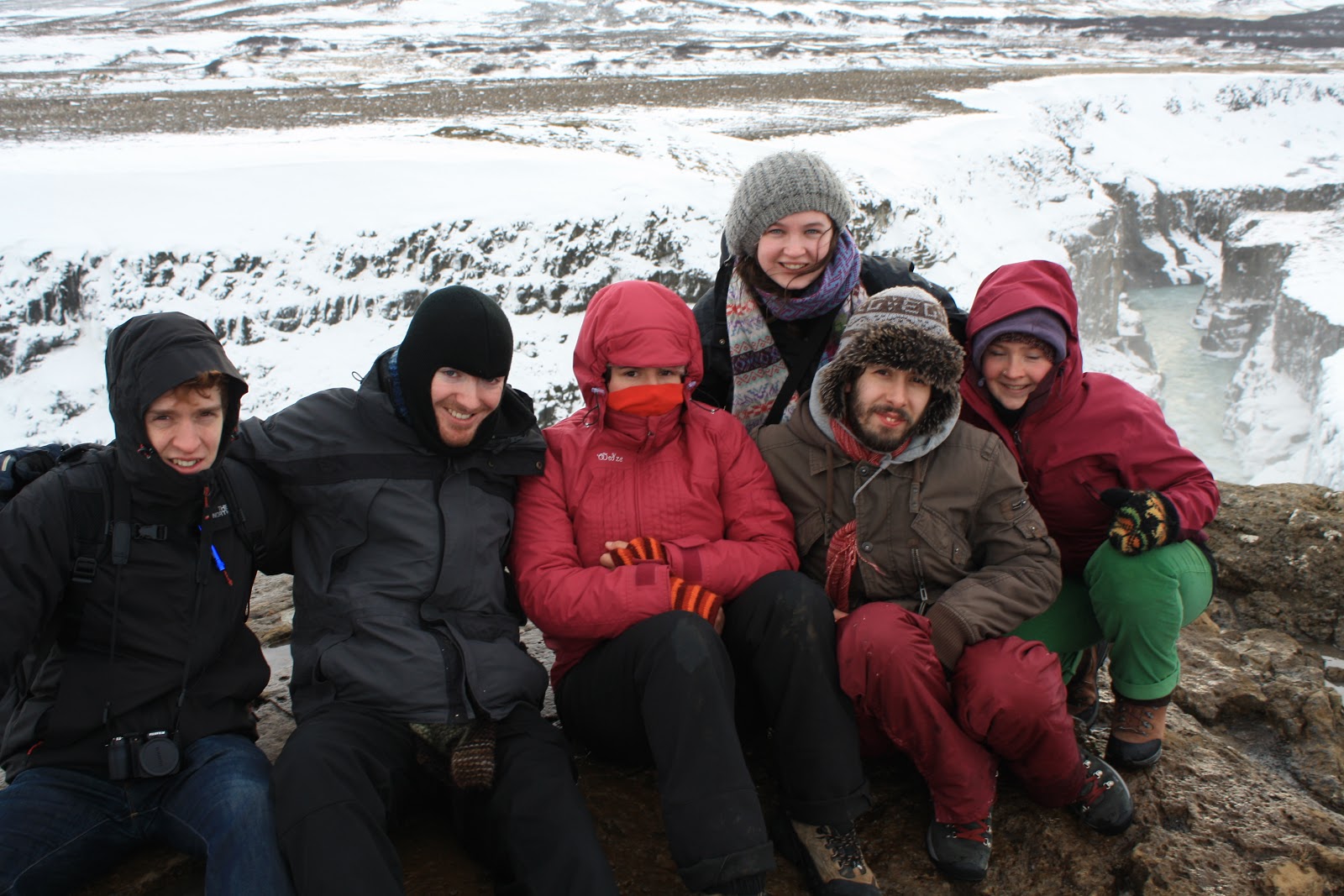
Since last we spoke (well, since I spoke; if this is a conversation I'm not being very equal with the discussion. That said, please do comment and discuss and revel in the new cultural pastime of blogmenting; Talk to me!) I've been to Reykjavik and back in one piece - although it was fairly touch and go at times - and we made a "class trip", so to speak, to Geysir, Gulfoss, and Þingvellir.  I won't bore you with the details of Reykjavik, but the other three are worth a mention.  

Þingvellir (pronounced "Thingvellir") was the site of the meeting of the Icelandic Parliament from 930 to 1789.  All the laws were discussed and decided there, so it's a very important place for Iceland's history.  It's also a hotbed of geothermal activity.  It sits on the continental drift between the North American and Eurasian Plates, and it's literally ripping at the seams.  Last week alone, they experienced something like 12 earthquakes there.  

The craic was mighty in Þingvellir...

Gulfoss is pretty self-explanatory when you see the pictures, but it's also pretty, hence the pictures.  


Geysir is even self-explanatory without pictures, but here are some anyway.  This geysir goes about every 7 minutes.  The larger one has been dormant for the past few years.  For a while they were able to prod it into activity by dumping loads of salt into it, but they gave that up after a while. 


Along with reading A Hitchhiker's Guide to the Galaxy and attempting to knit myself a pair of mittens, the discussions and debates that naturally arise when nine liberal-minded engaged people are put under the same roof are proving an interesting way to while away the Icelandic evenings.  Some of these conversations are less articulate than others; I have recollections of attempting to explain to Paulo how shareholders in a company work using cold, leftover chips as my medium after a decent amount of the cheapest wine we could find last week.  However, sharing insights and resources is always going to be valuable.  Thanks to Yvonne I've been watching Zeitgeist, which is a documentary that attempts to analyse the current malaise affecting humankind, addressing it from a cultural, religious, and financial standpoint.  I haven't finished it yet so I can't speak for it as a whole; what I can say is that it's free (you can watch it on YouTube or on the site) and that it raises some very good points.  I find its critique of corporate capitalism particularly interesting.  It's 2 hours and 41 minutes long, so if you're looking for something engaging to watch of an evening, I'd recommend it.  No indoctrination, no brainwashing.  Just have an open mind and you never know what it might inspire.  

~~~~~~

We're currently awaiting the potentially mind-blowing Northern Lights tonight, caused by the biggest solar flare in four years.  The only thing that might rain on our parade is the clouds (Sorry, couldn't resist...); last night was supposed to be even more spectacular than Monday, but there was nary a flicker seen through the foggy blanket.  We found our own spectacle, though - we went adventuring to an obscure natural hot pot, hidden away in the side of a mountain, nothing but a little snow-covered path off a dirt road (off a dirt road off a gravel road off a side road) and a No Camping sign to indicate its existence.  

On a night like last night, I can see why the Icelanders are so superstitious about elves.  There we were, sitting in volcanically heated water in what for all the world looked like a stone and peat-lined grave, surrounded on all sides by rolling hills bathed in eerie moonlight, the only sounds the trickling water and the howling wind.  So I did the only thing an able-minded, logical person would do: I sprinted out of the hot pot, soaking wet in the frigid wind, and dove back into the little hut we had put our clothes in to get my camera and take some pictures.   See if you can spot the elves.


The hardest part of hot-tubbing in Iceland is the entering and exiting.  As you're changing into your swimsuit, listening to the wind outside, you do question your sanity.  But once the barefoot speed-shuffle carries you to the water, you're grand.  You relax, forget about the whole thing, and turn to mush.  However, then comes the getting out bit.  It took a good 10 minutes to steel ourselves for the task.  When we all piled back into the little shed, we had to exercise our changing-in-the-dark-as-quickly-as-possible-before-hypothermia-onset talents (which I apparently do not possess, as I realised once we got home that the majority of my personal effects had been donned backwards and inside out.)  Despite its perils, it is always worth it, especially in as magical a setting as we were fortunate enough to enjoy last night.  Cheers, Mother Nature, you've done it again.

More photos here (also includes some pretty great Northern Lights shots from last week).

Thursday, February 3, 2011

Not So Vik-torious This Time...

Last weekend we set out for an adventure with our newly acquired wheels, and an adventure we received, albeit not in the manner we had anticipated.  It was probably the worst weather we've had since arriving: raining, sleeting, windy, cold, fairly miserable all around.  However, in Iceland if you let the weather scare you off you won't get up to all that much, so we piled into the cars anyway and headed along Route 1 (the only major road in the country outside of the capital) to Vik, which is the southernmost point of the island.

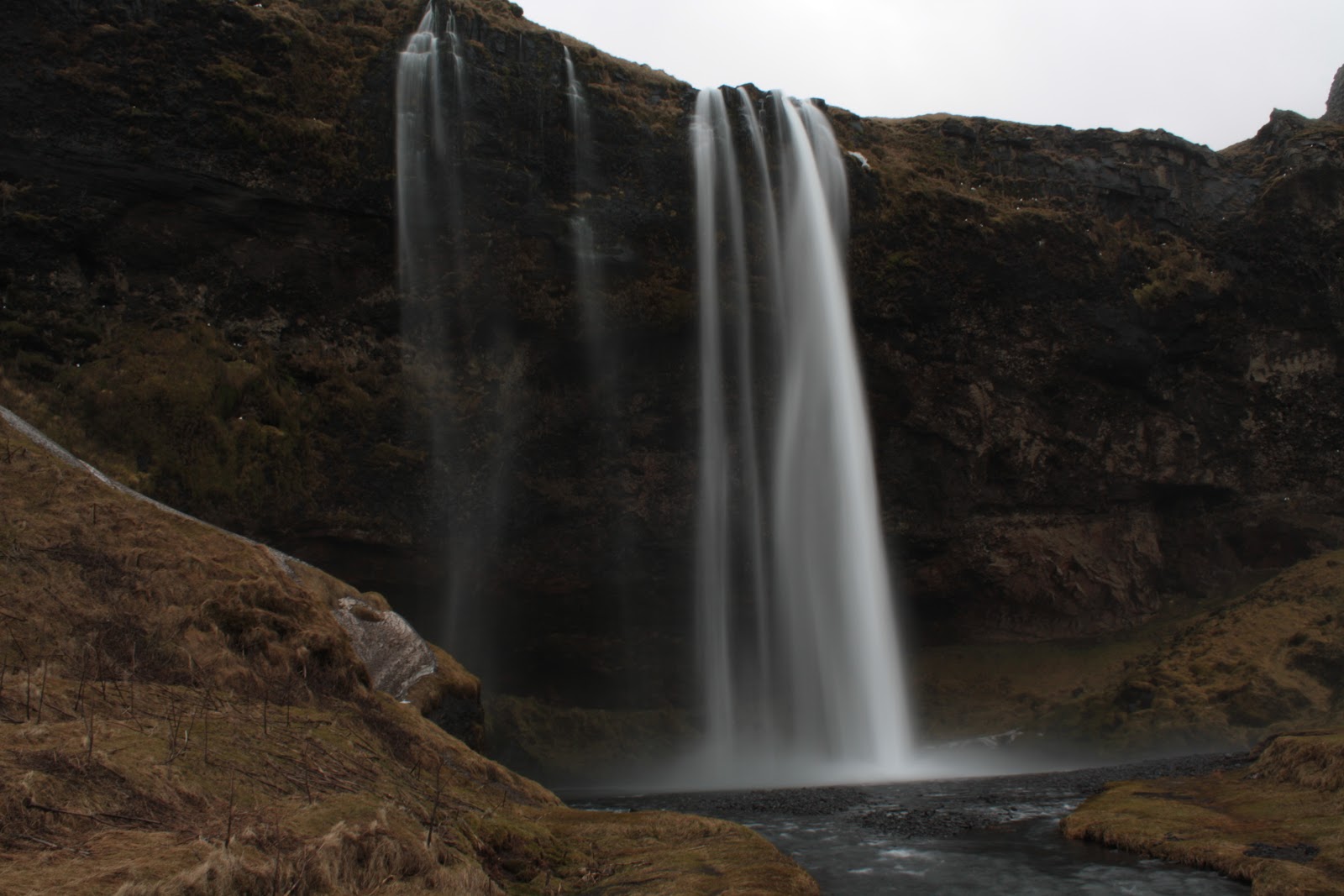
Our first stop was Seljalandsfoss, a waterfall just off of the Ring Road.  Its claim to fame is the fact that you can walk behind the water, making it a pretty impressive sight. My poor camera got fairly soaked between the rain and the spray from the falls, but I managed to get a few shots before scrambling up the snow-packed slope on the other side.


Ooooh, streaky...
We then proceeded down the Ring Road towards Vik, passing the infamous Eyjafjallajökull - you know, the one that caused all that chaos with European flights last year?  (Oh by the way, to all the English and Irish readers out there, I've been informed Iceland wants the ash back.  And yes, I can finally pronounce the name, more or less, correctly; my main goal in coming here has been accomplished.)  This particular stretch of road took quite some time, as every minute or so Paulo made us pull over because, "This is the farm that was in all the photos when the volcano erupted!"..."Actually I made a mistake back there, but this is the farm that was in the photos.  That other one, that was in some photos too."..."Look, guys, this is all ash from the volcano when it erupted!" At this point we thought it was appropriate to point out that the entire island was made up of volcanic ash, and it was time for lunch.  But here are the fruits of Paulo's labour anyway:

Famous Farm and Eyjafjallajökull

Well, if you can't beat them...
The weather worsened as we drove higher into the mountains; the rain became heavier, the fog thicker, but none of this mattered because we were nearly in Vik, and could scarcely imagine the wonders that awaited us there: quaint coffee shops, a cosy pub for a pint with the locals, perhaps a trendy hostel where we could spend the night revelling in the atmosphere of the town.  And then we arrived, after two and a half hours of driving, and we found...well, not a whole lot.  It was only after we got there that I learned the factoid of Vik's population: about 300, give or take.  And on a wet, stormy day in January, there may as well have been no-one there; we didn't see a soul.  

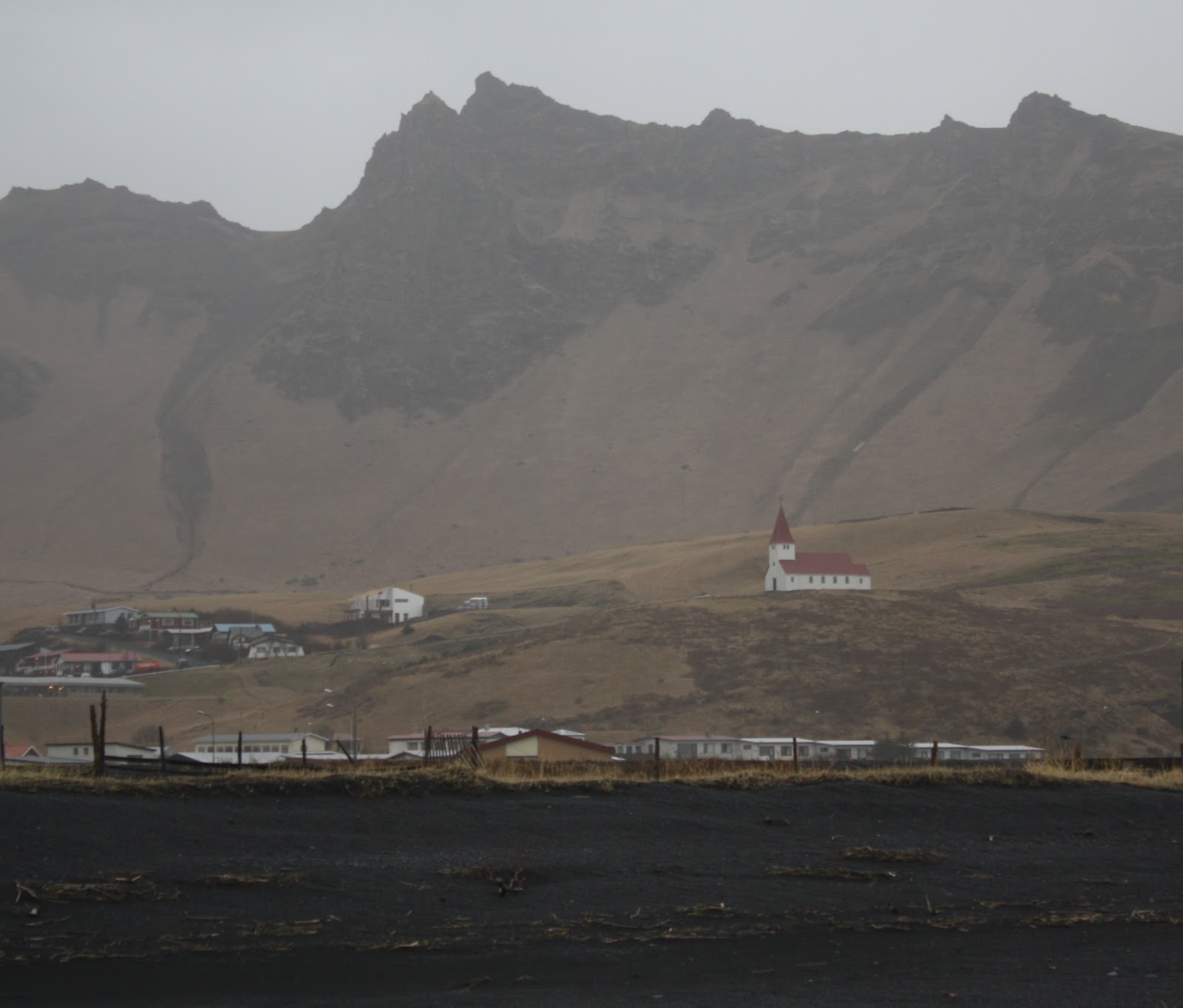
Spirits were a bit soggy at this point as we discussed what we should do next.  It was decided that those who could brave the elements would trudge a few minutes to the black sand beach Vik is famous for, and the rest would go in search of life to find out if there was any diversion to be found in the area.  I joined the ranks of the first group, and I'm really glad I did.  After scrambling over a hillock, down a ravine, through a running track (oddly enough), and over the dunes I was faced with a very pissed off Poseidon, and it was simply awesome (in the true sense of the word, inspiring awe, not in the "Dude, this piece of cheese totally looks like a turtle, awesome!" sense).  The sand, actually pulverised lava, had an inky sheen to it, and the waves were foamy masses of pure elemental rage.  The wind spat freezing rain at us, and its roar combined with the waves made talking to each other nearly impossible, so we just stared in silence.  It's one of those places that really needs to be experienced first-hand, and I'd encourage anyone who finds themselves in Iceland to do so.  Staring off into the Atlantic Ocean, being taunted and battered by the sea and wind, it makes you realise that despite all our civilisation and fancy habits, we really are at the mercy of the elements; we're just very poorly behaved guests.


On the way back to the cars, Paulo told me a bit about the town.  The church is the emergency meeting point for the villagers; when Katla erupts - it is a case of when rather than if: Katla is active and hasn't erupted since 1918, leading to speculation that it will erupt very soon, maybe even this year - it will completely obliterate the town, and the church is the only building high enough to potentially survive.  Now, since Katla's explosive tendancies are well-known, and Vik has had these issues before, it kind of begs the question why they didn't shift the town a few hundred meters up the mountain and to the left or right, out of the direct line of lava, but...I don't know.


Anyway, the other half of our group also had a successful jaunt.  While there was absolutely nothing open in the town, there was a good viewing point about a half hour's drive away that we could visit.  With the weather we were a bit concerned about the conditions of the road, but the locals had said they should be fine (remember this point; it will come in handy later).  We headed back up into the mountains, and turned off the paved road onto the gravel one.  Not great, but not too bad.  A minute or so later, we turned from the gravel road onto a dirt, now mud, road.  Not good, very bad.  Within half a minute both cars were stuck.  A Skoda and a Ford Focus do not an intrepid exploration convoy make.  

"The Crunch" in a bind
For the next hour and a half, the eight of us mucked about in the lashing rain, piling rocks under the wheels and bailing out mud with our hands and a couple of shovels we'd found by the nearby empty farm.  It all looked a bit futile, and we only had about an hour of daylight left.  Soaked and cold in the dark on a deserted road is not a fantastic situation to be in, all things considered.  However, one of our group had made friends with a girl who worked in a sandwich shop last time he was in Iceland.  That girl then went on to become part of Iceland's Search and Rescue team, and was stationed in Vik.  She also happened to be home that evening, and answered her phone.  I know, we are jammy dodgers indeed.  So after a very wet and muddy period of time, a massive wheeled Jeep came and pulled us out.  We all grinned like the very silly tourists we were and murmured "Takk fyrir" over and over until the poor cars were freed from their mucky graves and we were back on terra firma, scuttling our way back to Sólheimar.

All in all, I do believe our first excursion was a success.  We wanted an adventure, we got an adventure.  All the same, this weekend we've decided to play it slightly safer and head to Reykjavik, where hopefully the biggest mire we'll get ourselves into is trying to decide which pub to patronise.  

More photos here.